backhaul vs fronthaul
The rapid growth of mobile communication networks has transformed the way we connect, communicate, and consume data. With the proliferation of smartphones, IoT devices, and high-speed data services, the demand for efficient, high-capacity network infrastructure has never been greater. As mobile networks evolve from 4G LTE to 5G and beyond, understanding the architecture that supports these networks is essential. A key aspect of this architecture involves the relationship between backhaul vs fronthaul, two terms that play critical roles in ensuring network efficiency, speed, and reliability.
Telecommunication networks consist of multiple components working in unison to deliver seamless connectivity. The concepts of backhaul and fronthaul relate to the movement of data between different parts of the network, from cell towers to core networks and user devices. Clarifying the distinction between these elements helps network engineers, operators, and even tech enthusiasts understand the intricacies of modern communication systems.
The Basics of Mobile Network Architecture
Mobile networks are typically structured in layers. At the top, the core network manages central functions such as authentication, routing, and service delivery. At the edge, base stations or cell sites handle communication with user devices. Connecting these layers are links and transport networks that move data efficiently.
Within this framework, backhaul vs fronthaul refers to different segments of the transport network. Fronthaul connects remote radio units (RRUs) to baseband units (BBUs), essentially linking the radio interface to processing units. Backhaul, on the other hand, connects the baseband units to the core network, transporting aggregated data traffic to the central infrastructure. Understanding this distinction is crucial for network planning and optimization 5g wireless backhaul networks.
Historical Context: From 2G to 5G
In earlier generations of mobile networks such as 2G and 3G, the distinction between backhaul and fronthaul was less pronounced. Networks relied primarily on copper lines or microwave links, and the centralized processing model was simpler. As data traffic increased with 4G LTE, the need for higher capacity, lower latency, and efficient data aggregation became evident.
The rise of 5G has further emphasized the importance of differentiating backhaul vs fronthaul. 5G networks introduce concepts such as small cells, edge computing, and massive MIMO, which require precise coordination between the radio access network (RAN) and the core network. Fronthaul and backhaul now serve distinct roles in supporting ultra-low latency, high throughput, and dense network deployments.
Fronthaul: Definition and Function
Fronthaul refers to the segment of the mobile network that connects remote radio heads (RRHs) or radio units (RUs) to centralized baseband processing units (BBUs). This connection is critical because it transports digitized radio signals between the radio and the processing center.
One of the key characteristics of fronthaul is the need for extremely low latency. Since the fronthaul link handles real-time communication signals, any delay can affect network performance, resulting in dropped calls, buffering, or reduced data speeds. High-capacity fiber optic links are commonly used to meet these stringent requirements.
By examining backhaul vs fronthaul, it becomes clear that fronthaul is primarily concerned with transmitting raw radio data over short distances to centralized processing units. This segment is fundamental in architectures such as centralized RAN (C-RAN), which allows operators to consolidate processing resources and improve efficiency.
Backhaul: Definition and Function

Backhaul connects the baseband units or aggregation points to the core network, carrying user data, signaling, and management traffic over longer distances. Unlike fronthaul, backhaul handles aggregated traffic and does not require the extremely low latency necessary for real-time radio signals.
Backhaul networks can employ a variety of transmission mediums, including fiber optics, microwave links, or even satellite connections in remote areas. The primary goal of backhaul is to ensure reliable and high-capacity connectivity between distributed base stations and the central network, allowing services such as voice calls, video streaming, and internet access to function seamlessly.
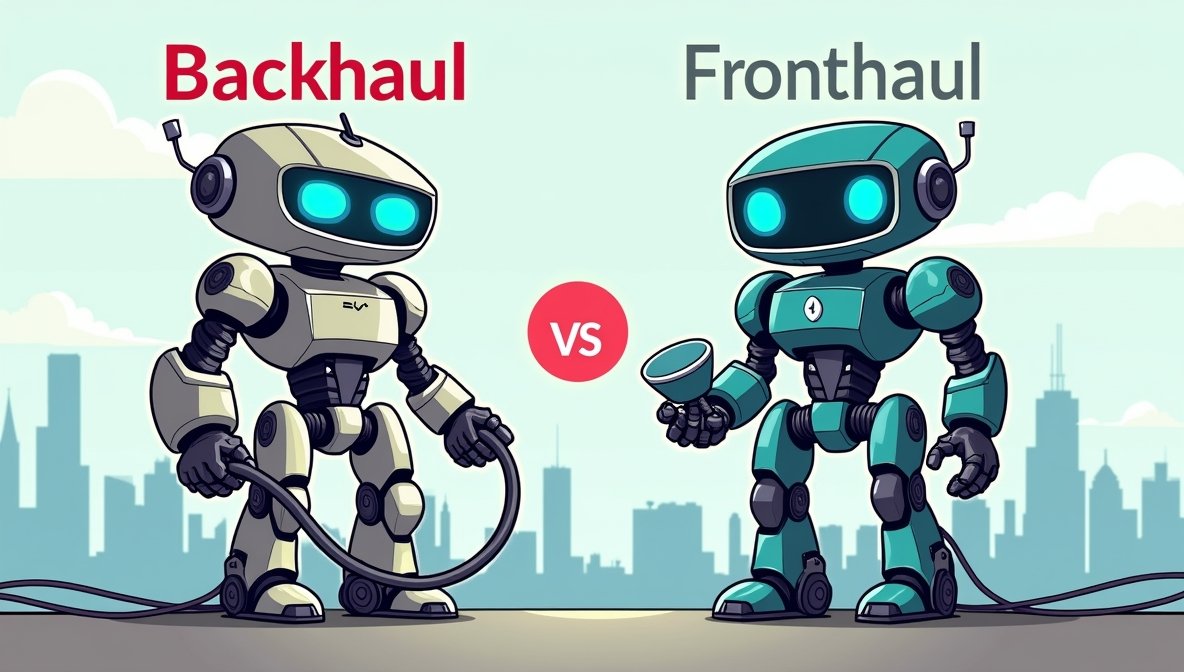
Comparing backhaul vs fronthaul highlights that backhaul focuses on efficiently transporting bulk data over longer distances, whereas fronthaul focuses on low-latency transport of raw radio signals over relatively short distances. Both are essential for overall network performance.
Transport Technologies in Fronthaul and Backhaul
Fronthaul networks typically rely on high-bandwidth, low-latency technologies. Common options include fiber optics with protocols such as CPRI (Common Public Radio Interface) or eCPRI, which facilitate digital transport of radio signals. These protocols allow precise timing and synchronization between radio and baseband units, essential for advanced features like massive MIMO and carrier aggregation.
Backhaul networks, in contrast, use a wider range of transport technologies depending on distance, capacity, and cost. Fiber optics remains the gold standard for high-capacity, long-distance links. Microwave and millimeter-wave links are employed where fiber deployment is challenging. Cellular backhaul networks must support not only high throughput but also redundancy and reliability to ensure continuous service.
Understanding the differences in transport technologies is a practical way to grasp backhaul vs fronthaul. While both segments require high performance, the emphasis in fronthaul is low latency and timing precision, whereas backhaul prioritizes scalability, bandwidth, and coverage.
Challenges in Fronthaul Deployment
Deploying fronthaul networks presents unique challenges. The high bandwidth and low latency requirements necessitate advanced infrastructure. Fiber installation can be expensive, especially in urban areas with complex civil works or in rural areas with difficult terrain.
Moreover, synchronization and timing precision are critical. Any deviation can affect signal quality and network efficiency. For operators implementing 5G, fronthaul links must also support functional splits, where processing tasks are distributed between radio units and centralized units, adding further complexity.
Comparing backhaul vs fronthaul, it is evident that fronthaul deployment is technically more demanding and often more costly per link due to stringent performance requirements.
Challenges in Backhaul Deployment
Backhaul networks face a different set of challenges. While latency is less critical than fronthaul, capacity and coverage are major considerations. As mobile data traffic grows exponentially, backhaul networks must scale to support higher throughput and maintain quality of service.
Geographical constraints can also impact backhaul deployment. Long distances, natural obstacles, and urban density influence the choice of transmission medium. Additionally, operators must design redundancy and failover mechanisms to prevent service disruptions.
By evaluating backhaul vs fronthaul, one can see that backhaul is more concerned with network resilience and scalability, whereas fronthaul is centered around ultra-low latency and precise timing. Both segments require careful planning to ensure end-to-end network performance.
The Role of C-RAN in Modern Networks
Centralized RAN (C-RAN) architecture has become a cornerstone of modern mobile networks, particularly for 4G LTE and 5G deployments. C-RAN centralizes baseband processing, allowing multiple remote radio units to share resources efficiently.
Fronthaul becomes a critical component in C-RAN because it links RRUs to the central baseband unit. High-capacity, low-latency connections ensure that signals from multiple radio sites can be processed in real time. Backhaul then transports aggregated traffic from the central baseband unit to the core network.
Understanding backhaul vs fronthaul in the context of C-RAN highlights how these segments complement each other. Fronthaul ensures real-time communication between radios and processing units, while backhaul connects these aggregated resources to the core network, maintaining overall service delivery.
Key Considerations for 5G Networks
5G networks introduce new requirements for both fronthaul and backhaul. Ultra-reliable low-latency communications (URLLC) and massive machine-type communications (mMTC) demand precise fronthaul links with minimal delays. At the same time, enhanced mobile broadband (eMBB) increases backhaul traffic significantly, requiring scalable high-capacity transport.
Network slicing, edge computing, and distributed architectures further complicate the landscape. Operators must balance investment between fronthaul and backhaul to ensure end-to-end performance. Exploring backhaul vs fronthaul in the 5G context provides insight into why operators often prioritize fiber deployment, functional splits, and edge processing to meet diverse service requirements.
Security Considerations

Both fronthaul and backhaul networks must be secured to protect against cyber threats, unauthorized access, and data interception. Fronthaul security focuses on protecting real-time radio data, whereas backhaul security emphasizes encryption and integrity of aggregated user traffic.
Deploying secure fronthaul links ensures that radio signals are not tampered with, while secure backhaul links maintain privacy and reliability of end-user data. Comparing backhaul vs fronthaul, one can see that while both require robust security measures, the focus areas differ due to the type of data they transport.
Cost Implications
The cost of deploying fronthaul and backhaul networks can vary significantly. Fronthaul deployment often involves higher per-link costs due to fiber installation, precision timing requirements, and high bandwidth needs. Backhaul, while sometimes using longer links, benefits from aggregated traffic, making per-unit cost lower but requiring investment in capacity and redundancy.
Operators evaluating backhaul vs fronthaul must consider both capital expenditures (CapEx) and operational expenditures (OpEx). Optimizing the balance between these segments ensures efficient network investment and long-term sustainability.
Future Trends
Emerging trends in mobile networks are reshaping how fronthaul and backhaul are implemented. Technologies like software-defined networking (SDN), network function virtualization (NFV), and open RAN (O-RAN) introduce flexibility, scalability, and automation.
Fronthaul networks will increasingly adopt eCPRI and packet-based transport, while backhaul networks may rely on high-capacity fiber and microwave links with enhanced routing capabilities. Understanding backhaul vs fronthaul is essential for keeping pace with these technological advancements and planning next-generation network deployments.
Conclusion: Integrating Fronthaul and Backhaul for Optimal Performance
In modern mobile networks, both fronthaul and backhaul are essential for delivering reliable, high-speed, and low-latency communication. Fronthaul connects radio units to baseband processing, focusing on real-time data and synchronization, while backhaul links baseband units to the core network, emphasizing capacity, reliability, and scalability.
Evaluating backhaul vs fronthaul highlights the complementary nature of these network segments. Efficient deployment, robust security, and strategic investment in both areas are critical for network operators, particularly as 5G continues to expand. By understanding these distinctions, engineers and decision-makers can design networks that meet the growing demands of modern mobile communication, ensuring seamless connectivity for users worldwide.
About the Author