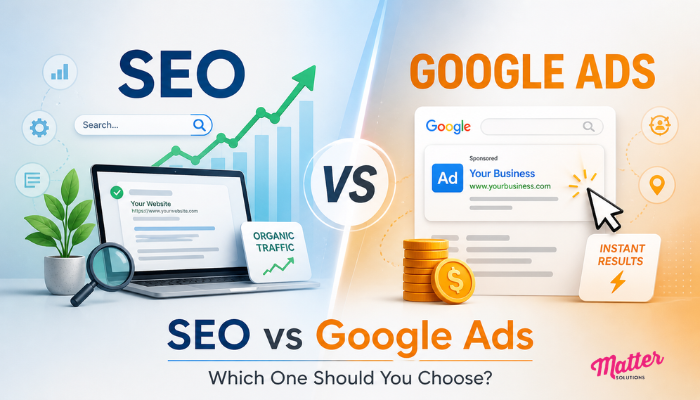
SEO vs Google Ads: Which One Should You Choose?
SEO vs. PPC is one of the most common questions business owners ask. And the frustration behind it is completely valid. SEO often feels slow, with no clear results for months. On the other hand, Google Ads can use up your budget quickly, and the traffic stops as soon as you stop paying
We handle both SEO and paid ads for businesses at Matter Solutions, so we see this debate play out every week. Most owners want to generate leads but have no idea which method will work for their goals.
In this article, we will cover how search engine optimization and Google Ads compare. You’ll also learn when to use each and how to choose the right marketing strategy for your business.
But before you pick a side, you need to understand how each fits into your broader plan.
SEO vs. PPC Explained for Modern Marketing Campaigns
Google Ads vs. SEO is not an either-or decision. Each one plays a different role inside a solid marketing strategy. That’s why picking the right one comes down to your goals, your budget, and how quickly you need results.
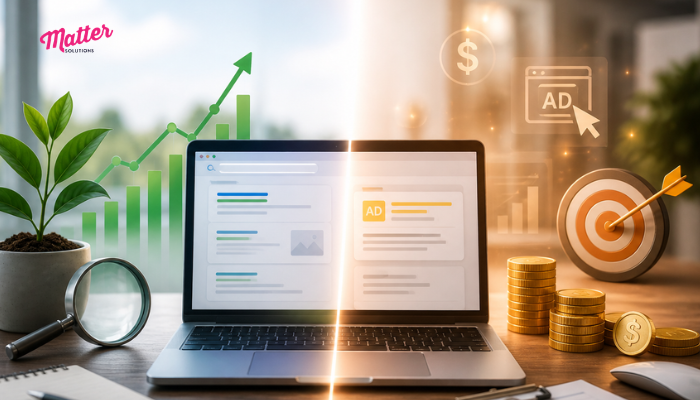
Let us break down where each one fits so you can see the full picture.
Where SEO Fits in a Digital Marketing Strategy
Search engine optimization (SEO) is the process of improving your website so it shows up higher in organic search results. In simple terms, it helps people find you on Google without you paying for each click.
Most of this work starts with content marketing. You create helpful articles that answer the questions your potential customers are already searching for. Then, you build pages around the topics that are most important to them.
As search engines recognize that effort gradually, your rankings improve, and more people start finding your website on their own. If you are wondering what this actually means for your business in practice, here are the benefits and trade-offs:
The Benefit
According to a BrightEdge study, organic search drives around 53% of all website traffic. And because users tend to trust organic listings more than ads, high rankings also help you build credibility with your audience. That kind of customer engagement is very hard to replicate with paid campaigns alone.
The Tradeoff
SEO is not a quick win. It can take anywhere from three to six months before you notice movement in your rankings. You also need to keep publishing and updating content to hold your position.
But once your pages start ranking consistently, it can bring visitors to your site for months or even years without adding much to your costs.
Where Google Ads (PPC) Fits in a Digital Marketing Strategy
Google Ads works on a pay-per-click (PPC) model, which means you pay every time someone clicks your ad. As soon as you launch a campaign, your listing can appear right at the top of Google search results.
Let’s look at both the advantages and the limitations more closely.
The Benefits
Paid ads bring in traffic quickly, which helps when you need leads right away or want to test a new message. You can target specific audiences using location, keywords, and buyer data. Plus, you stay in control with flexible budgets and clear performance tracking.
That kind of measurable success is the reason so many businesses choose to run PPC campaigns right alongside their SEO work.
The Tradeoff
Now, the downside, as you know, is cost dependency. The second you stop paying, the traffic disappears with it. And in competitive industries like legal services, finance, insurance, and e-commerce, the cost per click can rise fast. This can eat into your returns gradually if you are not watching things closely.
SEO vs. PPC Decision Framework for Choosing the Right Strategy
The best lead generation method for your business depends on five things. But most businesses get stuck comparing SEO and PPC in isolation.
So, here is a simple framework to help you figure out what fits.
Factor 1: Your Timeline for Results
If you need traffic and leads within the next few weeks, PPC is the faster option. Google Ads can place your listing at the top of search results the same day you launch a campaign. This makes it a natural fit for things like a new product launch or a limited-time promotion.
However, SEO takes longer to build momentum. As we mentioned, it usually requires three to six months of steady effort before your pages start ranking well enough to generate leads consistently.
The upside is that once those rankings settle in, they keep working for you over time. So if your priority is long-term brand growth, SEO can be the stronger path forward.
Factor 2: Budget and Financial Resources
With PPC, you pay for every single click. This means in competitive industries, like finance or legal services, a single click can cost $5 to $50 or more (and that spending adds up quickly). Your financial resources need to support that cost month after month for the traffic to keep flowing.
SEO works differently, though. It requires an upfront investment in content, technical improvements, and site structure. However, those costs tend to shrink as the results grow.
In fact, when you compare the cost per qualified lead over a full year, SEO almost always comes out ahead. On average, SEO converts at 2.4%, while PPC sits closer to 1.3%. That gap means more leads for less money over time.
Factor 3: Lead Quality and Intent
People who find your website through organic search are usually further along in their buying process. In other words, they are actively looking for answers and type in specific questions when they search.
So if they come across your content and click on it, it’s because it feels relevant and helpful to their need. That kind of intent naturally produces better lead quality and stronger lead qualification rates.
Now, PPC can reach high-intent users too, but the results depend heavily on your targeting. For instance, you can send targeted messages to very specific audiences using buyer personas and keyword data, which gives you more control. Still, not every click will come from someone ready to act.
That’s why we recommend using a lead scoring system to help your sales team sort through those leads. Basically, your team assigns points based on each prospect’s actions and interest level. It allows your sales team to focus on the prospects most likely to convert into customers.
This process drives effective lead generation because your team spends time on the prospects most likely to buy.
Factor 4: Your Marketing Ecosystem
SEO fits naturally alongside content marketing, email marketing, and social media channels.
For example, you can reuse a blog post that ranks well on Google as an email newsletter. Or you can share it across social media platforms to reach even more people. This way, each channel feeds into the next, and the whole system gets stronger because of it.
In contrast, PPC connects with a different set of tools. It pairs well with dedicated landing pages, focused marketing campaigns, and conversion tracking setups. Together, they show where your money goes and the return you get from each dollar spent.
Factor 5: Testing and Data Strategy
One of the main advantages of running PPC campaigns is the speed of feedback. You can launch an ad, collect keyword data, and find out which messages connect with your target audience within just a few days.
Interestingly, experienced marketers often use PPC as a testing ground first before applying what they learn to SEO. They run paid ads to see which headlines or offers get the best response from users. Then they use those winning ideas to guide their organic content.
And if a certain headline or offer performs well in a paid ad, it will likely do well as the foundation for an organic page, too. Over time, you can use this combination to build a digital strategy where both channels make each other stronger.
Combine SEO and PPC for Immediate and Long-Term Results
So, after going through this online marketing comparison, which direction feels right for you?
Based on our experience running both channels for years, the best results rarely come from picking just one. PPC brings in immediate traffic and helps you test what works. SEO, meanwhile, builds the kind of long-term growth that keeps your site generating leads well after a campaign wraps up.
If you want help putting that kind of plan together, contact Matter Solutions, and we will walk you through it.
About the Author