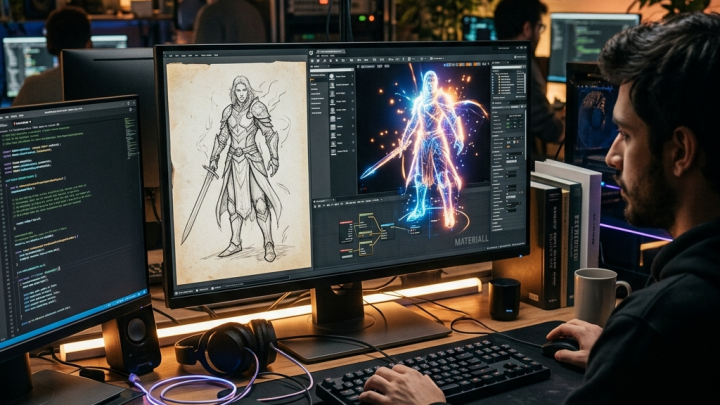
The independent gaming industry is currently experiencing a massive surge in ambition and scope. Small development teams are no longer restricted to building simple 2D platformers; they are actively designing expansive, three-dimensional open worlds that rival the visual complexity of major studio releases. However, the primary bottleneck for these ambitious projects remains the sheer volume of 3D assets required to populate a virtual environment. Traditional manual modeling is highly resource-intensive, often depleting a small team’s budget before the core gameplay loop is even finished. To overcome this financial barrier, developers are turning to generative artificial intelligence. At the forefront of this movement is Neural4D, an advanced spatial generation system jointly developed by Nanjing University, DreamTech, Oxford University, and Fudan University. This robust academic framework is actively democratizing the game development process.
When a solo developer or a small indie studio needs to rapidly prototype a new character or environmental prop, they can now utilize an AI 3D model generator free of the exorbitant licensing costs associated with enterprise modeling software. Instead of spending weeks manually extruding geometry, developers can simply input a piece of 2D concept art. The neural network processes this image and instantly outputs a fully optimized 3D mesh. This capability allows independent teams to focus their limited resources on narrative design and gameplay mechanics rather than technical asset creation.
Breaking the Modeling Bottleneck
The creation of a single usable 3D game asset is an intricate, multi-stage discipline. A technical artist must build the base geometry, ensure the topology flows correctly for animation, unwrap the UV map, and paint the surface textures. For a team building a bustling cyberpunk city or a dense fantasy forest, manually executing this pipeline thousands of times is an impossibility.
Generative AI disrupts this linear workflow by automating the most labor-intensive technical phases. By leveraging volumetric depth estimation, the system can instantly deduce the spatial properties of a flat, two-dimensional sketch.
> The true value of this automation lies in its architectural optimization. The generative engine does not just output a solid block of digital clay; it calculates and generates a highly efficient quad-dominant mesh. This ensures the resulting geometry is lightweight enough to run smoothly in standard game engines without causing frame-rate drops.
The Automated Texturing Pipeline
An optimized mesh is critical for performance, but the visual identity of a game relies heavily on texturing. In modern game engines like Unity or Unreal Engine, surfaces must react dynamically to virtual light sources. A metal sword must reflect sunlight differently than a wooden shield.
To achieve this optical accuracy, advanced generative platforms utilize intrinsic decomposition to project proper materials onto the newly generated mesh.
1. Base Color Extraction: The system analyzes the original concept art and applies the core color palette to the model without baking in any artificial shadows.
2. Roughness Calculation: The AI mathematically determines how glossy or matte each specific surface should be, separating metallic armor from soft fabrics.
3. Normal Generation: The neural network calculates high-frequency surface details, simulating the appearance of complex depth, such as brickwork or skin pores, without adding unnecessary polygons to the game engine’s rendering queue.
This comprehensive material extraction ensures that AI-generated assets meet the stringent visual requirements of modern 3D gaming.
Fostering Collaborative Game Ecosystems
While generative platforms are excellent for creating bespoke hero assets, indie developers rarely build every single item in their game entirely from scratch. A sprawling video game level requires hundreds of generic background props, such as barrels, streetlights, or basic furniture. Dedicating generative computing time to these mundane items is an inefficient use of a developer’s workflow.
Instead, intelligent independent teams operate within hybrid ecosystems. For generic environmental dressing, developers frequently access repositories of DIY3D community models. By downloading pre-optimized, open-source background assets from these collaborative networks, developers can quickly block out the architecture of their game levels. They then reserve the generative AI exclusively for creating their unique, proprietary characters and story-critical items. Merging AI-generated hero models with community-sourced background geometry is currently the most efficient methodology for building expansive virtual worlds on an indie budget.
A New Era of Game Development
The integration of automated 3D reconstruction technology marks a permanent shift in how independent video games are manufactured. By eliminating the steep financial and technical barriers of manual polygon manipulation, generative AI provides small teams with the asset pipelines previously reserved for massive corporate studios. The ability to instantly transition a piece of 2D concept art into a fully rigged, texturally accurate 3D game asset ensures that creative vision is no longer constrained by modeling budgets. As these neural frameworks become more deeply integrated into standard game engines, the capacity for independent developers to build highly immersive, spatially complex digital experiences will expand exponentially, permanently altering the landscape of interactive entertainment.
About the Author